


Salt Lake City Lawn Care Tips: A Seasonal Guide
If you’ve ever watched a green spring lawn turn patchy and brown by late July, you already know that lawn care in Salt Lake City plays by different rules than the advice you’ll find in a national gardening magazine. Between our alkaline clay soil, a short mountain growing season, and summers that regularly push past 95 degrees with almost no rain, a lawn here needs a plan built around the Salt Lake Valley, not around Ohio or Georgia.
| Quick Fact | Salt Lake Valley Guideline |
|---|---|
| Best grass type | Kentucky bluegrass or bluegrass/fescue blend (cool season) |
| Mowing height | 3 to 4 inches |
| Watering, summer | 1.5 inches per week, split into 2 to 3 deep waterings |
| Watering, spring/fall | 1 inch per week |
| Soil type | Dense, alkaline clay (former Lake Bonneville lakebed) |
| Best aeration window | Early fall, paired with overseeding |
| Average annual precipitation | ~15 inches |
| Xeriscape rebate programs | Localscapes and Flip Your Strip |
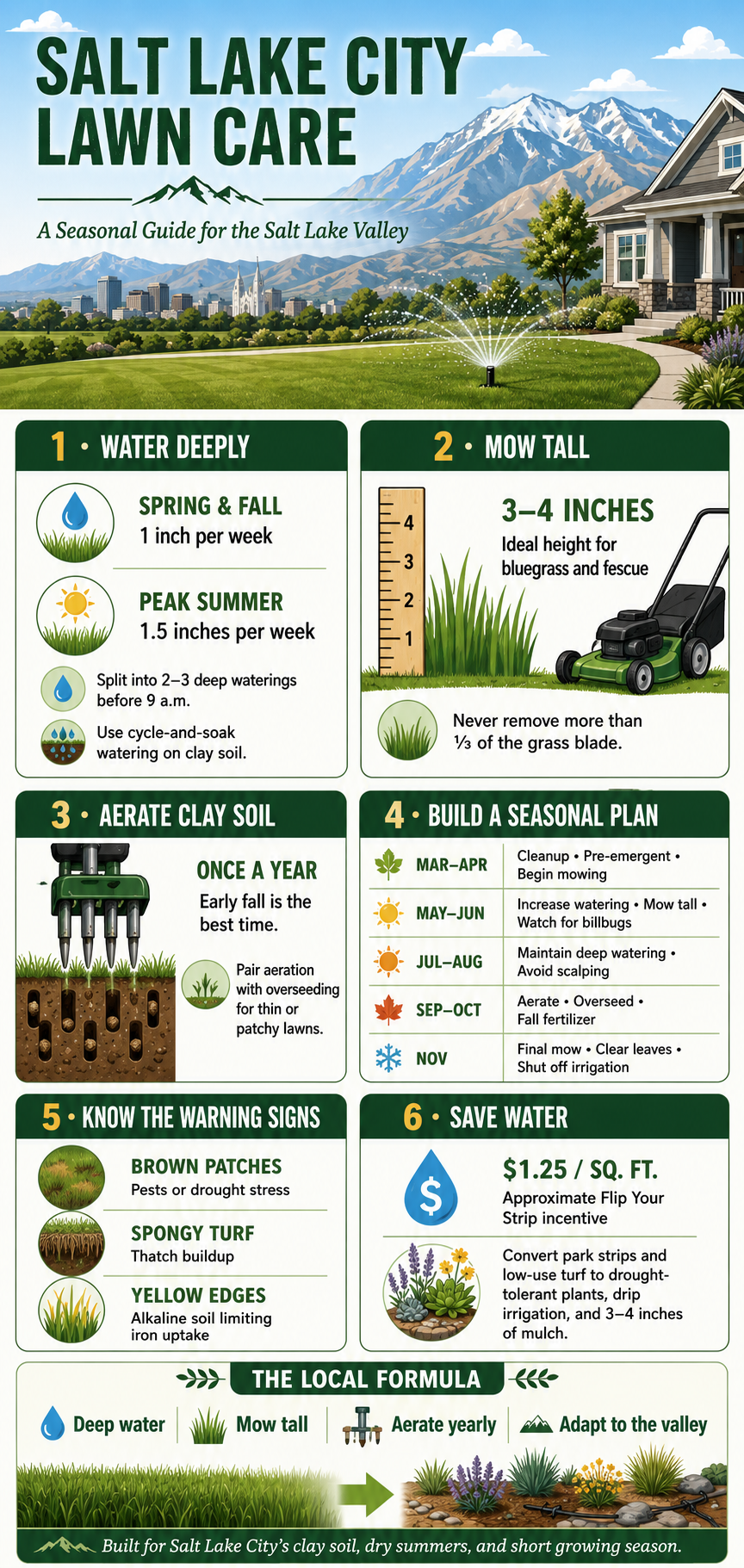
The short answer is that a healthy Salt Lake City lawn depends on watering deeply but infrequently, mowing cool season grass tall, aerating compacted clay soil every year, and timing fertilizer around our valley’s growing season rather than the calendar date. Get those four things right and most of the common lawn problems homeowners see across the valley clear up on their own.
A few things every Salt Lake City homeowner should know before the growing season starts:
- Most lawns in the valley are Kentucky bluegrass or a bluegrass and fescue blend, both cool season grasses that go semi-dormant in the peak of summer heat.
- Salt Lake City’s clay soil compacts quickly, which is why so many lawns here struggle even when they’re watered on schedule.
- The valley gets roughly 15 inches of precipitation a year, most of it in winter and spring, so summer lawn health depends almost entirely on irrigation.
- City watering ordinances restrict daytime irrigation, and programs like Localscapes and Flip Your Strip actively pay homeowners to reduce turf area.
- Lawns on the west side of the valley and lawns up against the Wasatch benches often need different watering schedules because of soil and sun exposure differences.
Why Salt Lake City Lawns Behave Differently
Salt Lake City sits in a high desert valley at roughly 4,300 feet, which means intense summer sun, low humidity, and wide temperature swings between day and night. That combination pulls moisture out of soil fast, and it’s a big part of why lawns here brown out in August even when they looked fine in June.
The valley’s soil is another factor. Much of the ground from Sugar House to Millcreek to West Valley City sits on dense, alkaline clay left behind by ancient Lake Bonneville. Clay holds water well on the surface but resists letting it soak down to the root zone, so a lawn can look overwatered and be drought stressed at the same time. Neighborhoods along the benches, from Holladay up toward the foothills, often have rockier, faster draining soil that needs a different watering approach than the valley floor.
At Step-A-Head Landscaping, we’ve worked on properties across the Salt Lake Valley long enough to see the same pattern over and over. Homeowners follow generic lawn care advice, get frustrated when it doesn’t work, and assume something is wrong with their yard. Almost always, the advice just wasn’t written for our soil, our elevation, or our water restrictions. Once we adjust the plan for local conditions, the lawn responds.
How much should you water a Salt Lake City lawn?
A Salt Lake City lawn typically needs about 1 inch of water per week in May and September and closer to 1.5 inches per week during peak summer heat, split across two or three deep waterings rather than a daily light sprinkle. Watering deeply and less often trains grass roots to grow deeper into the clay, which makes the lawn far more drought tolerant by midsummer.
Because Salt Lake City and neighboring cities restrict outdoor watering during daytime hours, early morning is both the most efficient and the most compliant time to run sprinklers. Watering before 9 a.m. cuts down on evaporation loss in our dry air and gives grass blades time to dry out before evening, which helps prevent fungal problems. Lawns on clay soil often do better with a cycle and soak approach, running the sprinklers for a shorter interval, pausing to let water absorb, then repeating, instead of one long cycle that just runs off the surface.
| Season | Recommended Watering | Notes |
|---|---|---|
| Spring (April to May) | 1 inch per week | Ease sprinklers back on gradually as growth resumes |
| Early Fall (September) | 1 inch per week | Cooler temps reduce evaporation loss |
| Peak Summer (June to August) | 1.5 inches per week | Split into 2 to 3 deep waterings, before 9 a.m. |
| Late Fall (October to November) | Taper down, then shut off | Reduce as the lawn heads into dormancy |
What’s the best mowing height for lawns in the Salt Lake Valley?
Most lawns in the Salt Lake Valley do best mowed to 3 to 4 inches, which is taller than many homeowners expect. Taller grass shades the soil, slows evaporation, and helps bluegrass and fescue lawns survive our hot, dry summers with less stress and less watering.
Scalping a lawn short might look tidy for a few days, but in our climate it exposes soil to direct sun and speeds up moisture loss, which is exactly what a clay soil lawn can’t afford in July. We also recommend the one third rule: never cut more than a third of the blade length in a single mow. On a fast growing spring lawn that can mean mowing every five days instead of stretching to a weekly schedule, and letting clippings fall back into the lawn to return moisture and nutrients to the soil.
Why does core aeration matter so much here?
Core aeration matters in Salt Lake City because our compacted clay soil blocks water, air, and nutrients from reaching grass roots, and pulling small soil plugs relieves that compaction so the lawn can actually use what you’re feeding it. Most valley lawns benefit from aeration once a year, and lawns with heavy foot traffic or older, more compacted soil often do better with aeration in both spring and fall.
Fall aeration paired with overseeding is one of the highest impact things a Salt Lake City homeowner can do for a thin or patchy lawn. Cooler fall temperatures and lower evaporation give new grass seed a much better chance to establish before winter than a spring seeding does, since spring seedlings often hit summer heat before their roots are established.
Not sure if your lawn needs aeration, a watering fix, or a full renovation? At Step-A-Head Landscaping, we provide professional lawn care in Salt Lake City, we can help. We’ll walk your property and build a plan around what’s actually going on in your soil.
Desert Landscaping and Water-Wise Alternatives for Salt Lake City Yards
Desert landscaping in Salt Lake City means replacing thirsty turf areas, especially park strips and low-use side yards, with drought tolerant plants, mulch, and efficient drip irrigation designed for our high desert climate. Local programs make this one of the more practical upgrades a homeowner can make, both for water bills and for long-term yard maintenance.
Utah’s Localscapes program and the statewide Flip Your Strip initiative both offer cash incentives for converting traditional lawn to water-wise landscaping. Flip Your Strip currently pays around $1.25 per square foot for converting the park strip between the sidewalk and street, while Localscapes rebates have covered a meaningful share of the cost for a typical quarter acre yard conversion. Utah State University Extension and the Localscapes framework both point toward native and adapted plants such as buffalograss, blue grama, sheep fescue, Utah serviceberry, and prairie sagewort, all of which use a fraction of the water a Kentucky bluegrass lawn needs once established.
A well-designed desert landscape doesn’t have to look like gravel and cactus. We typically recommend keeping a smaller, functional patch of turf where kids and pets actually use the yard, then converting park strips, side yards, and other low-traffic areas to drought tolerant plantings with drip irrigation and 3 to 4 inches of mulch to hold moisture in the soil. That combination cuts outdoor water use significantly while still leaving a yard that looks intentional and green, not abandoned.
Common Lawn Problems in Salt Lake City
The most common lawn problems in the Salt Lake Valley are drought stress from underwatering clay soil, thatch buildup in older Kentucky bluegrass lawns, and billbug or grub damage that shows up as irregular brown patches in mid to late summer. Most of these problems trace back to watering habits or soil compaction rather than the grass itself.
| What You’re Seeing | Likely Local Cause |
|---|---|
| Brown patches that don’t respond to extra water | Billbugs or grubs feeding on roots, not drought stress |
| Spongy, thick lawn that feels dry even after watering | A thatch layer blocking water from reaching the soil |
| Yellowing along sidewalks and driveways | Alkaline soil pH near concrete limiting iron uptake |
| Crabgrass and summer annual weeds moving in | Thin, stressed turf, often from mowing too short in a hot, dry stretch |
| West-facing slopes or benches stressing out first | Faster evaporation and drainage on sloped, sun-exposed ground |
When should you call a professional lawn care company?
It’s worth calling a professional when a lawn doesn’t respond to consistent watering and mowing adjustments, when brown patches keep spreading despite irrigation, or when a fall renovation like aeration and overseeding feels like more equipment and timing than you want to manage yourself. Diagnosing whether a problem is watering, soil, pests, or disease often takes an experienced eye, especially in a valley where several of those issues can look identical from the surface.
We also see homeowners reach out when they’re ready to reduce their water bill with a park strip or side yard conversion but aren’t sure which plants will actually thrive in their soil and sun exposure. A quick site visit usually answers that faster than trial and error over a full growing season.
If your lawn needs a plan built around Salt Lake City’s soil and climate rather than generic advice, our lawn care services are built specifically around the valley’s growing conditions, from spring green-up through fall aeration and overseeding.
Salt Lake City Lawn Care Calendar
A Salt Lake City lawn care calendar generally starts with a spring cleanup and pre-emergent application in March or April, moves into regular mowing and deep watering through the summer, and shifts to aeration, overseeding, and fall fertilizing from September through October. Winter is mostly a rest period, though late fall cleanup and a final mow help the lawn go into dormancy in better shape.
| Time of Year | Lawn Care Task |
|---|---|
| Late March to April | Dethatch if needed, apply pre-emergent weed control, begin mowing as growth resumes |
| May to June | Increase watering as temperatures climb, mow tall, watch for early billbug activity |
| July to August | Hold watering steady through peak heat, avoid scalping, treat active pest or weed pressure quickly |
| September to October | Aerate, overseed thin areas, apply fall fertilizer to build root strength before winter |
| November | Final mow at a slightly lower height, clear leaves, reduce or shut off irrigation as the lawn goes dormant |
Common Mistakes Salt Lake City Homeowners Make
The most common mistake we see is watering too often for too short a time, which trains roots to stay shallow and leaves the lawn vulnerable the moment temperatures spike. A close second is mowing too short in an attempt to reduce mowing frequency, which backfires by exposing soil in a climate that already loses moisture fast.
Skipping aeration is another frequent issue, since compacted clay soil doesn’t announce itself the way a pest problem does. A lawn can go several seasons looking merely mediocre before an owner realizes compaction is the underlying cause. Finally, plenty of homeowners either ignore the park strip entirely or keep watering it like a lawn, missing an easy opportunity to cut water use and qualify for a Flip Your Strip rebate.
Ready for a Lawn Care Plan Built for Salt Lake City?
A lawn in the Salt Lake Valley can absolutely thrive, it just needs a plan that respects our clay soil, our short growing season, and our dry summers instead of fighting against them. Whether that means fine-tuning a watering schedule, catching up on aeration, or converting a thirsty park strip into a water-wise localscape, Step-A-Head Landscaping is ready to build a plan around your property.